The first feature you use is not inside the houseA beautiful property can make buyers look past the road that leads to it. The view, privacy, trees, shop, or extra land may feel like the headline,
Dated: September 22 2026
Views: 16
The first feature you use is not inside the house
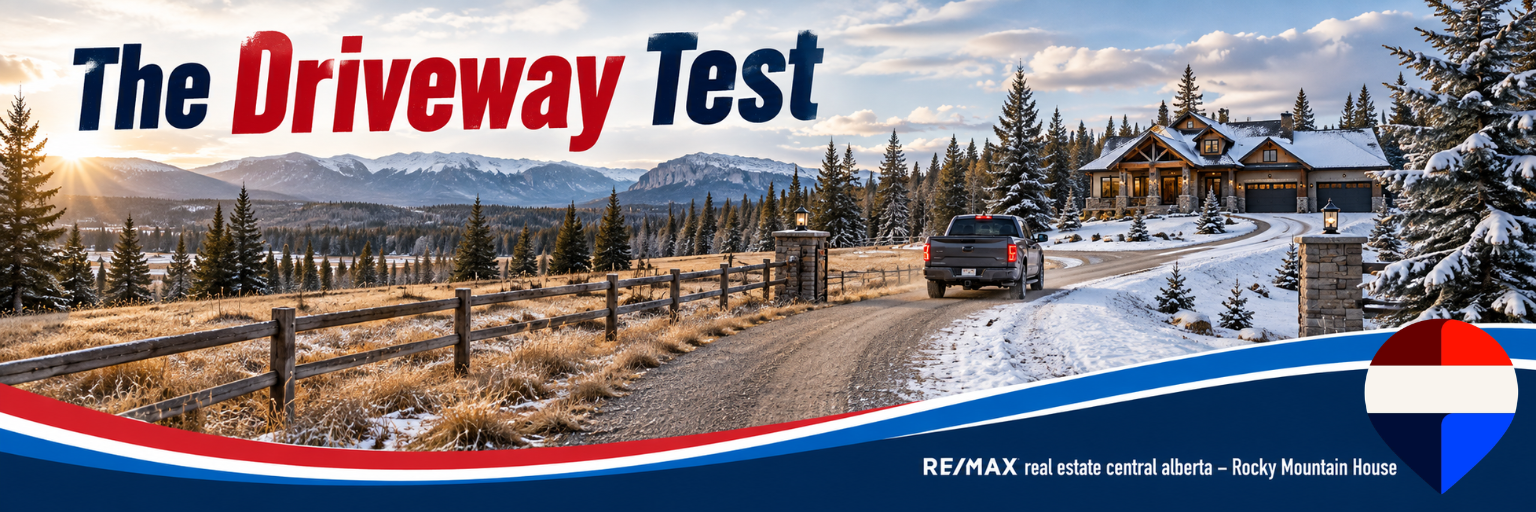
A beautiful property can make buyers look past the road that leads to it. The view, privacy, trees, shop, or extra land may feel like the headline, while the driveway is treated as a small detail. In reality, access is used every time someone leaves for work, returns with groceries, receives a delivery, brings home a trailer, welcomes a guest, or needs help in difficult weather.
For anyone buying property near Rocky Mountain House Alberta, the driveway test is a practical way to examine how the property will function through all seasons. It applies to homes in town, at the edge of town, in subdivisions, and on rural parcels. The questions change with the setting, but the principle stays the same: access affects safety, maintenance, cost, and daily convenience.
Drive it slowly in both directions
During a showing, drive the complete access route slowly. Notice sightlines when entering the road and when turning back into the property. Check the grade, curves, width, surface, shoulders, ditches, culverts, gates, and places where two vehicles could pass. Look for low areas, washouts, loose gravel, ruts, overhanging branches, and signs that water crosses the driving surface.
Then imagine the route with snowbanks, darkness, fog, spring thaw, or a delivery truck. A turn that feels easy in a compact vehicle may be difficult with a trailer. A steep section that looks manageable when dry may need regular sanding in winter. A narrow approach may affect moving trucks, service vehicles, or equipment. If possible, enter and leave more than once rather than making the driveway a single pass on the way to the front door.
Find out who owns and maintains each section
Do not assume that every road leading to the property is maintained by the same authority or on the same schedule. Identify where public maintenance ends and private responsibility begins. Ask who grades gravel, clears snow, repairs culverts, controls vegetation, and pays for shared access. If there is an easement or shared driveway, review the registered documents and understand how costs and decisions are handled.
Within the Town of Rocky Mountain House, the municipality publishes information about road maintenance, snow removal, parking bans, closures, and construction. Provincial highways are handled separately. Outside town limits, responsibilities may involve Clearwater County, the province, private owners, or an access agreement. The listing description is not a substitute for verification. A real estate professional and the appropriate authority can help buyers identify which questions need formal answers before conditions are removed.
Estimate the winter workload
A long driveway can provide privacy, but it also creates a winter job. Measure or estimate the length and width. Look for room to push or pile snow without blocking visibility, drainage, gates, parking, or septic components. Notice whether wind exposure may cause drifting. Ask what equipment the current owner uses, how long clearing typically takes, and whether a local contractor services the area.
Consider backup plans. If the main snow removal equipment fails during a storm, can another machine access the property? Is there a safe place to turn around? Does the household need to leave early for shift work or school before a contractor arrives? Budget for fuel, maintenance, equipment, or hired service. The cost may be entirely worthwhile for the setting, but it should be understood before purchase rather than discovered during the first heavy snowfall.
Follow the water
Driveways are part of a property's drainage system. Water should move away without eroding the surface, flooding a garage, damaging landscaping, or overwhelming a culvert. Look at ditch direction, culvert openings, sediment, soft shoulders, and the transition between the driveway and public road. Fresh gravel can improve appearance without explaining why repairs were needed.
Ask about spring conditions and major rain events. Review available property information, permits, and inspection advice. If concerns are visible, seek the appropriate professional opinion. Drainage problems may be repairable, but buyers need a realistic view of the scope. A driveway that repeatedly washes out or directs water toward structures can create more than an inconvenience.
Test turning, parking, and delivery access
The driveway does not end at the house. Look at the parking and turning area. Can vehicles exit facing forward? Can a moving truck, fuel delivery, septic service vehicle, or emergency responder reach the required area? If a shop or garage is part of the property's appeal, can the intended vehicle or equipment actually approach and turn without crossing soft ground or making a difficult reverse movement?
Open gates and garage doors when permitted. Check clearances. Measure trailer paths. Notice whether parked vehicles block access to outbuildings or create a bottleneck near the home. These details are especially important when several household members leave at different times, when work vehicles are involved, or when recreational equipment is used regularly.
Map the ordinary week
Privacy feels different when every errand requires an extra trip. Before buying, map work, school, groceries, health care, fuel, sports, and the places visited most often. Drive at the times that matter. Check cellular coverage where safe and note areas where winter conditions or wildlife commonly change the pace of travel. Ask how school transportation, waste service, and deliveries apply to the specific address.
The right calculation is personal. A buyer who works from home and values quiet may happily accept a longer drive. A family with several evening activities may prefer a simpler route. Rocky Mountain House offers services, recreation, and community amenities, including an established paved multipurpose trail within town, while surrounding areas offer a wide range of rural settings. The best property balances the setting you want with the travel pattern you can sustain.
Consider emergency access without becoming alarmed
Emergency access is a practical planning question, not a reason to reject rural living. Confirm that the civic address is visible. Notice whether gates, narrow corners, low branches, or parked equipment could delay access. Ask where vehicles can turn around and how the route is maintained during storms. Understand how the property is reached if one section of the driveway is blocked.
Households can also plan for ordinary disruptions by keeping appropriate supplies, maintaining vehicles, and knowing who to contact for road or driveway service. A property that is well prepared can offer both privacy and confidence. The important step is to evaluate access honestly instead of assuming that every season will resemble the day of the showing.
Make access part of the offer decision
The driveway test helps buyers compare properties beyond emotion. One home may need gravel and improved drainage but offer a manageable route. Another may require equipment, ongoing contracted service, or legal clarity about shared access. Those differences belong in the budget and the purchase decision alongside the roof, heating system, well, septic system, and outbuildings.
RE/MAX real estate central alberta Rocky Mountain House can help you ask the right local questions and gather the information needed to evaluate a property carefully. The road home should support the life you are buying the property to create. Taking time to test access in detail can protect both the experience and the investment.
RE/MAX real estate central alberta Rocky Mountain House

Rose Reis - Marketing Specialist | Real Estate & BoldTrail Assistant With nine years of experience in both digital and traditional marketing, I specialize in helping real estate agents streamline the....
The first feature you use is not inside the houseA beautiful property can make buyers look past the road that leads to it. The view, privacy, trees, shop, or extra land may feel like the headline,
Buying a home is usually described as a decision for one household. But what if your household includes an aging parent, an adult child returning home, or family members who want to live close
What Rocky Mountain House acreage buyers should notice beyond the front doorWhen buyers tour an acreage, the house naturally gets most of the attention. They picture furniture in the living room,
A colder morning can expose details buyers miss in mild weatherMost buyers hope for a bright, comfortable day when they tour a home. In Rocky Mountain House, however, one of the most useful showings
 Data is supplied by Pillar 9™ MLS® System. Pillar 9™ is the owner of the copyright in its MLS® System. Data is deemed reliable but is not guaranteed accurate by Pillar 9™. The trademarks MLS®, Multiple Listing Service® and the associated logos are owned by The Canadian Real Estate Association (CREA) and identify the quality of services provided by real estate professionals who are members of CREA. Used under license.
Last Update: September 23, 2026 3:13 AM UT
C
Show More...
Data is supplied by Pillar 9™ MLS® System. Pillar 9™ is the owner of the copyright in its MLS® System. Data is deemed reliable but is not guaranteed accurate by Pillar 9™. The trademarks MLS®, Multiple Listing Service® and the associated logos are owned by The Canadian Real Estate Association (CREA) and identify the quality of services provided by real estate professionals who are members of CREA. Used under license.
Last Update: September 23, 2026 3:13 AM UT
C
Show More...
 All information deemed reliable but not guaranteed. All properties are subject to prior sale, change or withdrawal. Neither listing broker(s) or information provider(s) shall be responsible for any typographical errors, misinformation, misprints and shall be held totally harmless. Listing(s) information is provided for consumer's personal, non-commercial use and may not be used for any purpose other than to identify prospective properties consumers may be interested in purchasing. The data relating
to real estate for sale on this website comes in part from the Internet Data Exchange program of the Multiple Listing Service. Real estate listings held by brokerage firms other than REMAX Real Estate Central Alberta - RMH may be marked with the Internet Data Exchange logo and detailed information about those properties will include the name of the listing broker(s) when required by the MLS. Copyright ©2026 All rights reserved.
Last Updated: September 23, 2026 1:01 AM UTC
Show More...
All information deemed reliable but not guaranteed. All properties are subject to prior sale, change or withdrawal. Neither listing broker(s) or information provider(s) shall be responsible for any typographical errors, misinformation, misprints and shall be held totally harmless. Listing(s) information is provided for consumer's personal, non-commercial use and may not be used for any purpose other than to identify prospective properties consumers may be interested in purchasing. The data relating
to real estate for sale on this website comes in part from the Internet Data Exchange program of the Multiple Listing Service. Real estate listings held by brokerage firms other than REMAX Real Estate Central Alberta - RMH may be marked with the Internet Data Exchange logo and detailed information about those properties will include the name of the listing broker(s) when required by the MLS. Copyright ©2026 All rights reserved.
Last Updated: September 23, 2026 1:01 AM UTC
Show More...